
September 3, 2026
By Maria Wiering
A black-and-white drawing of Saint Paul shows the saint standing with his left arm holding a book, and his right hand resting on the hilt of a sword stuck in a tree stump. Behind him, stars of various shapes swirl over cityscapes and arch over his halo, which is inset with many small circles. The whole image is framed within an arch, which contains two shields: One shows a snake and fire, and the other reads “Pavlvs Apostolvs” — the Apostle Paul, in the style of a classical Latin inscription.
There is, one might say, a lot going on. But the details have meaning.
The full-page image is one of the first drawings in “Treasury of Catholic Prayers,” a prayer book and gift for Catholic students of the Archdiocese of Saint Paul and Minneapolis from Archbishop Bernard Hebda. It’s one of three full-page images commissioned especially for the 70-page book, which contains traditional Catholic prayers, ranging from the Our Father to the Litany of Loreto.
The artist, Daniel Mitsui, is renowned for his distinctive style that blends the ancient with the contemporary, drawing from illuminated medieval manuscripts, Celtic ornamentation and Japanese woodblock prints.
Mitsui, who lives in Indiana, also uses traditional iconography, or the symbols and images associated with a particular saint. Saint Paul’s sword is the instrument of his martyrdom, and so is the tree stump — a chopping block recalling his beheading under the Roman Emperor Nero around A.D. 67. The pose of the apostle — the Archdiocese’s primary patron — is based on a 15th-century woodcut, Mitsui said.
“When I draw Saint Paul with his sword, it’s not a battle sword; it’s an executioner’s sword, which is why it’s so long, and why it has a square end instead of a pointed end,” he explained, noting that the inspiration for Saint Paul’s sword is anachronistic — it’s modeled after an artifact from the Middle Ages he viewed at the Cleveland Museum of Art.
The cities behind Paul represent the Christian communities he wrote to: Corinth, Colossae, Ephesus, Galatia, Philippi, Rome and Thessalonica. “In some older medieval Books of Hours from the 14th century, they would decorate the calendars with this sort of symbolic arrangement, (in) which each page for a month would show Saint Paul … (or) one of the other New Testament epistle writers alongside one of the prophets, and they would be passing a brick between, showing the building up of the Church,” Mitsui said.
The whimsical stars, he said, are one of his signature decorative motifs.
“I like to draw the stars as being varied rather than just the same, five-pointed geometric over again, because I think that’s both more indicative of the natural reality, which is that the heavens are not … real regular. There’s a lot of variety up there, and that also says certain things about God — and that it’s not dull or predictable,” he said.
Hidden in the undulating flora at Saint Paul’s feet are three springs of water: A legend holds that when Saint Paul was beheaded, his head bounced twice and then landed, and a fountain appeared at each point. Mitsui was inspired by a medieval tapestry that included the three fountains, he noted. In southern Rome, the Cistercian Abbey of the Three Fountains stewards the site where this is said to have occurred.
One shield — a coat of arms — shows a serpent being tossed into fire. It’s a reference to Acts 28:3-6, which describes a venomous viper latching onto Paul’s hand, and the apostle fearlessly shaking it off into the fire, unharmed.
The cover art, in color, is of Christ Crucified, with four candidates for sainthood linked to the Archdiocese: Blesseds Father Solanus Casey (1870-1957) and Brother James Miller (1944-1982), who lived part of their lives in the Archdiocese; the soon-to-be beatified Archbishop Fulton Sheen (1895-1979), who attended The Saint Paul Seminary; and Bishop Frederic Baraga (1797-1868), whose missionary expeditions included Minnesota’s North Shore.
Mitsui depicted them as they might be seen in an old cathedral, he said, holding their “attributes,” or associated symbols. Blessed Solanus holds his violin; Bishop Baraga, with the title “venerable,” stands with a snowshoe for his moniker “the Snowshoe Priest;” Blessed James, a handyman, holds a wrench; and Archbishop Sheen holds a piece of chalk.
“I was like, it would be too tacky to show him (Archbishop Sheen) holding his Emmy Award or something, so I’m like, well, how about his chalk?” Mitsui said. “He always had the chalkboard” — his visual aid on “Life is Worth Living,” the archbishop’s 1950s television program.
The accompanying plants and animals on the cover’s background are specific to America and particularly the upper Midwest, he noted. Because Minnesota made him think of lakes, he incorporated frogs and Virginia creeper, a woody vine native to the state.
While he drew the black-and-white images by hand using ink on paper before scanning them for digital use, he created the cover on goat skin.

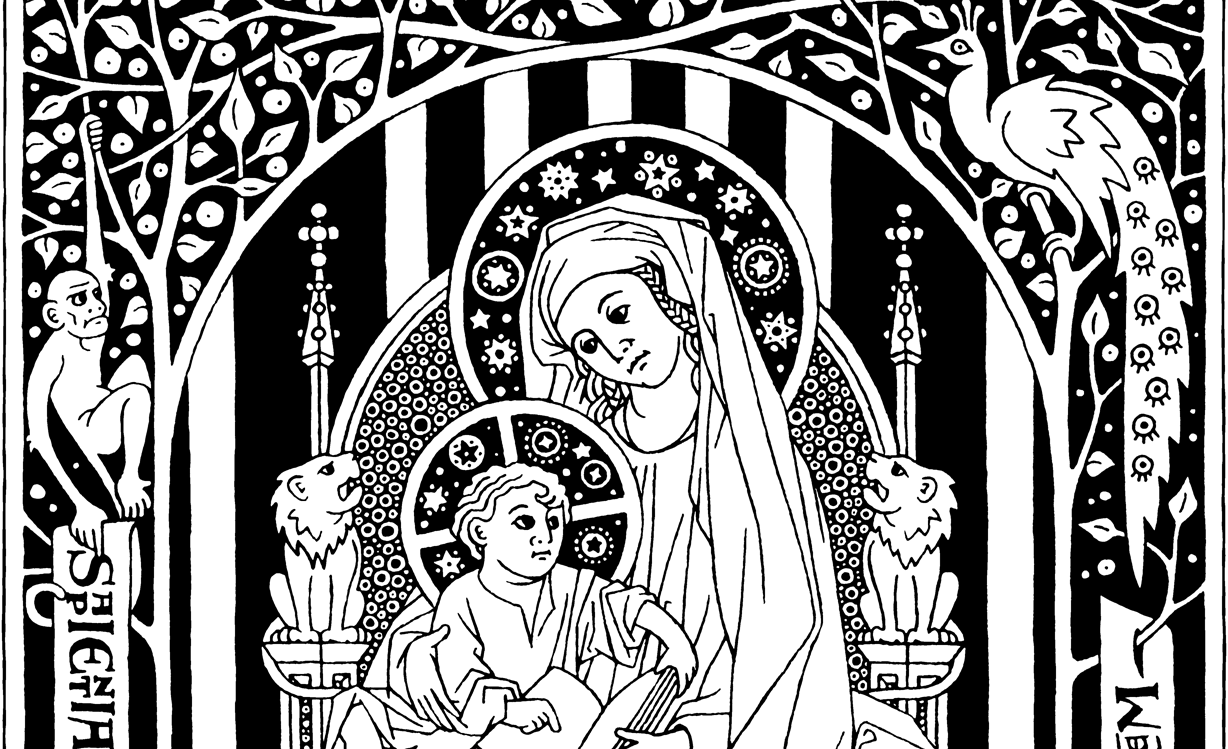
The third page-size image Mitsui created for the work is Our Lady, Seat of Wisdom, who is the patroness of the Archdiocese’s Catholic school system. The image introduces the section titled “Prayers to Mother Mary.”
The main image shows Mary seated with the Child Jesus holding a book, drawing from iconography of the Seat of Wisdom, a traditional Catholic devotional title for Mary.
“I like the idea of connecting that (image) with educational wisdom, because this is for school kids,” Mitsui said. “You see sometimes pictures of Saint Anne and Mary in that sort of same (posture), with Anne teaching Mary to read, but this has shifted down a generation.”
While Mitsui was inspired by another image of Our Lady, Seat of Wisdom that showed the Infant Jesus “crinkling” a page of a book, he said, “I made him more of a toddler here, where he could presumably be where she would be reading to him, and not just entertaining him.”
Under them, tucked into winding plants, is Mary’s title in Latin: “Sedes Sapientiae.” Bordering the image in vertical banners is a verse from Proverbs 1: “Wisdom has built her house, she has set up her seven columns.”
The seven columns, or pillars, noted in Proverbs are represented as stripes behind the figures. The pillars allude to the number seven symbolizing completeness in Scripture, as well as the seven gifts of the Holy Spirit and the seven virtues. Similarly, the step of Mary’s throne and the two stationary lions on its arms also nod to biblical numerology; the throne of King Solomon — who was renowned for his wisdom — was described in 1 Kings 10:18-20 as having six steps flanked with 12 lion statues.
The prayer book’s original art — which also includes a bookplate with an image of Saint Paul — is complemented throughout by smaller images Mitsui added from previous work: Saint Michael the Archangel, the Madonna and Child, and the Holy Family. Meanwhile, each page is elaborately bordered with images of tiny mushrooms, oak leaves, turtles and doves, or mythical creatures, ivy and sea life.
“That’s based on a style of tapestry, mostly a 15th-century style called ‘millefleur’” — literally, “thousand flowers” — “and so you see a lot of late medieval tapestries that have all these little plants and often animals that are kind of put together” to fill space, he said.
While the purpose of the prayer book is to introduce or further instill common prayers into the minds and hearts of its young readers, Mitsui acknowledges that his art might also fascinate the students — and adults — who hold his work in their hands.
“The medieval style that I tend to work in, and that I definitely favored for this project, is one that I think is appealing to kids,” he said. “My favorite children’s book illustrations’ illustrators are ones who take the work very seriously and produce works of art that don’t really seem like they are geared directly toward kids — they just sort of happen to be, and that’s the approach I’m taking.
“I do think there’s a certain kind of playfulness in my artwork, generally speaking, especially with some of the marginal illustrations and things like that,” he said, “but it’s something I do for everyone. It’s not just for one audience or another.”
His main hope, he said, “is just that it’s appropriate and as worthy as I can make it of the subject matter that it accompanies. … I want to do the best that I can.”